Graffiti Art: Why it should NOT be taboo

Montreal is a city filled with a diversity of art and everything about art such as graffiti. However, most graffiti pieces are not fully appreciated by the public since its subject used to be controversial back when its modern popularity arose. However, its origin’s date way back in the stone ages in cave paintings created by our ancestors. These cave paintings were depictions of our ancestor’s hunting stories, legends and war stories; since languages were limited at the time. In the 21st century, graffiti was originally rejected and still struggles for full acceptance by the public. Most graffiti pieces are either depictions of political and social messages. True to its purpose, it records human activity and overall history that express social and political content that may come off as controversial that trigger a particular- group, but also serve awareness and historical movements.

Since the beginning of 1970’s, hip-hop culture influenced many to start street art that consisted bright colorful spray paint on public areas. Most times, the act of spray painting was famously used by the group, the crews, to mark their territory away from other gangs. Graffiti art became famous by its unique styles of color and shapes, but it was debated whether it was an actual art form. It was hard to identify it as an art form because most places declared it as vandalism and illegal.

Throughout the years of different styles of spray painting, it struggled to make its acceptance to the public which inspired artists to create pieces that spread its expression against disapproval. Since both social and political graffiti art was portrayed offensive, it was best for most artists to conceal their identity from threats and direct negative feedback that only god knows what could happen to them.

One artist, Banksy, works with stencil graffiti that depicts social and political messages. The artist’s identity remains unknown and is believed to have been born in Bristol, England in 1974. Banksy began his graffiti career in the 1990’s when he began working with stencils. Following his artwork, he moved to London around 2000. One of his art work, Graffiti is a Crime, depicts two children reaching for a spray paint can that was crossed off with the sign, graffiti is a crime. Ironically, the title itself goes against the traditional notion of banning graffiti; which associates to the children rebelling against its social ideation of street art.
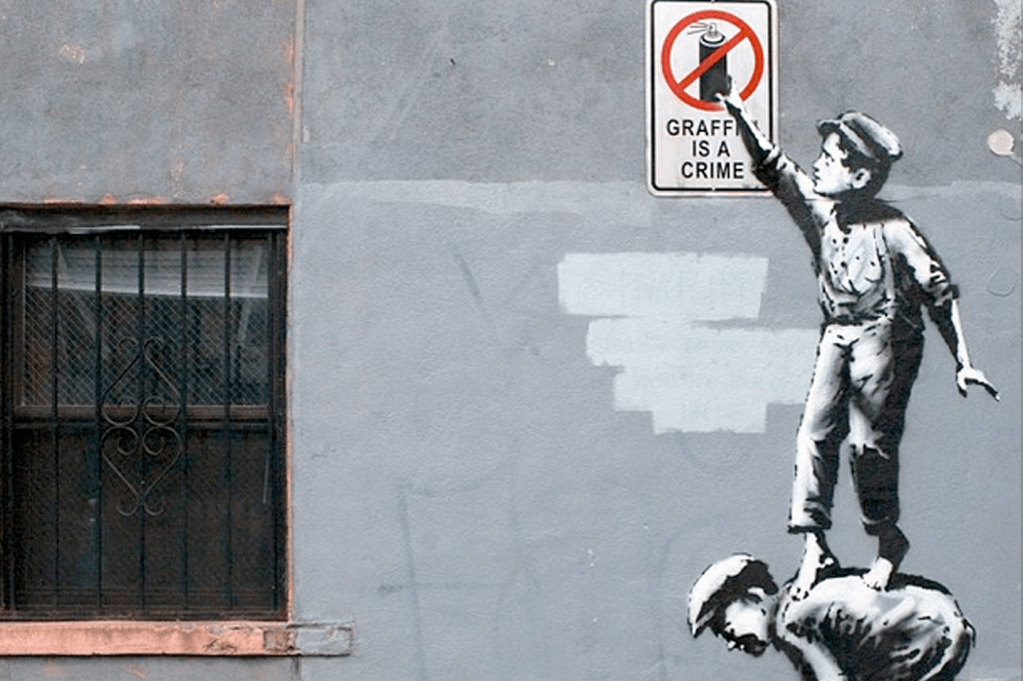
Graffiti is a Crime by Banksy
http://boredbug.com/wp-content/uploads/2014/11/graffiti-is-a-crime.png

“Graffiti is one of the few tools you have if you have almost nothing. And even if you don’t come up with a picture to cure world poverty you can make someone smile while they’re having a piss.”– Banksy

Graffiti art has been known since the stone ages and became popular in modern times that expressed historical, social, and political issues within the public. Its practice and overall content is normally rejected by the public and government and is often seen as vandalism, which struggled to meet its acceptance in art form. The young generation may have a different, and more positive, perspective. However, the older generation that mainly own these public properties that contain beautiful street art murals, may have an issue with graffiti because of its non- traditional aesthetics and controversial content that may offend some. Although graffiti art is not entirely accepted by society’s perspective of art form, true art speaks to its viewers whether it brings the outcome of negative or positive feedback. Art surrounds us everywhere.

Abstract Painting: What does it mean?

When entering a museum, you notice odd looking paintings that may seem effortlessly painted contrasting from the fine art paintings of portraits and landscapes. Normally, the viewers would receive the impression of the minimal efforts when creating these abstract paintings. Despite its appearance, it contains its equal amount of effort, emotion, meaning, and sometimes, far more aesthetics that tell meanings in depth. While viewing an abstract painting, the viewer may not identify its meaning or story because of its indistinct aesthetics on canvas however, it delivers a form of feeling and emotion. Abstract art has been around over 100 years that included artists such as Jackson Pollock.

Working Title/Artist: Autumn Rhythm (Number 30)Department: Modern and Contemporary ArtCulture/Period/Location: HB/TOA Date Code: 11Working Date: 1950 Digital Photo File Name: DT1407.tif Online Publications Edited By Steven Paneccasio for TOAH 2/13/14 Image blurry especially along left edge

Abstract Expressionism began in the 1940’s in New York. The art movement is originally inspired by its legacy, the Surrealism art movement. Its colorful splatters and shapes were not only meant to attract its viewers, but to also feel emotions that the artists felt during the artistic process of producing abstract paintings. Abstract expression focused on the artist’s personal experiences and emotions that were expressed in painting. In result, the artist’s technique consists vigorous arm movements that portrayed anger, sadness, and all sorts of emotions.

Jackson Pollock is one of the most famous American expressionist abstract paintings. He was born in Cody, Wyoming in 1912. He grew up in Arizona and Chico, California. In his early life, he encountered some Native American culture while on trips with his father, whom was a surveyor for the government at the time. Although his art is not particularly inspired by his Native American cultural experiences, he works with memory and early enthusiasms. In 1939, The Museum of Modern Art in New York City established a Picasso exhibition, Picasso: 40 Years of His Art, which contained 344 works of Pablo Picasso and his famous anti-war mural, Guernica. The exhibit led Pollock to recognize the expressive power of European modernism, which he had previously rejected in favor of American art. He began to forge a new style of semi-abstract totemic compositions, refined through obsessive reworking. One of Pollock’s signature painting techniques, the drip and splash, consisted a canvas mounted on the wall or on the floor, having the artist able to aggressively spray paint with consistent movement with his upper body holding the brush. His action painting is known for one of the most well-known pieces produced in historical art movement in the Abstract era.

Jackson Pollock in action painting process
https://www.jackson-pollock.org/images/jackson-pollock-paint.jpg

“The painting has a life of its own. I try to let it come through” – Jackson Pollock

Now that you have an insight of what those odd-looking paintings are, you can acknowledge that abstract painting is far more than the flick of the wrist and meaningless messages. Abstract painting contains the emotion of the painter’s attempt of offering their personal experiences and unveiled expression through bright, dull, and dark colors through splatters, shapes, and overall indistinct images. It not only contains the action of expressing through its artistic processes but, rather abstract images of a building, a bike, or a field of flowers that express its very subject associated to the artist’s deeper perspective of things.

Feminist Art: 2 Powerful Artists that Helped change the perspective of Women

When we think about feminism, it is not the prettiest to view upon the most shocking realities as it is looking at a beautiful woman. Feminist art is a form of body art that manipulates the stereotypical image of a woman’s body. Back in the day, it was common for women to be portrayed as objects and the most underestimated amongst the public’s perspective. It was a time of unequal rights of basically being a human. In unfortunate deaths and sexual abuse cases, investigations were not committed at its best efforts; the violence continued. Although it was the most difficult, women gathered campaigns, protests, and awareness of what should be done to end the mistreatments and unequal rights against women. In the 1960’s, it was a time of being an independent woman without leaning on a man; which angered many. After years of fighting and protesting, more women were mysteriously killed, and more feminist artists gathered. Despite the tragic deaths of numerous women, it inspired feminist artists to step forward and create body art that not only caused controversies amongst the public, but a huge impact upon society that helped change the perspective of women.

In the 1970’s, artists such as Ana Mendieta had a huge start with creating controversial art that not only angered many but had a huge impact back then to today’s society. Ana Mendieta was born in 1948 in Havana, Cuba. When she turned 12 years old, she was sent to America alongside her sister by the government who organized a sponsorship for Cuban children to flee Fidel Castro’s dictatorship. With little English language, she managed to graduate high- school and later decided to attend the University of Iowa. During her studies at the University, one of her classmates got raped and killed on campus; which inspired Ana Mendieta to act into creating one of the most shocking feminist arts at the time.

The art work, “Untitled (Rape scene)”, is a colored photograph of Ana Mendieta tied up and facing down in a bent position on her table; exposing her buttocks smeared with cow’s blood. This depiction not only addressed feminism, but an act of justice that influenced the reality of rape and murder against women.

Untitled (Rape scene) by Ana Mendieta http://lauraolohan.files.wordpress.com/2013/10/kc_femart_mendiet_69.jpg

Today, women around the world still face unequal treatments by the government, the job industry, and overall society. It is a shame to acknowledge that women do not receive the same amount wage as men and facing increased rates of domestic and sexual abuse daily. In 2019, women perform an estimated 2.6 times the amount of unpaid care and domestic work that men performed, according to a survey by the United Nations. In addition, women also face major issues from society’s perspective of how they dress, how they act, and their overall sexuality. Despite a woman’s private life of making their own life decisions, their sexual and appearances are portrayed as taboo. If a woman has sex, she is labeled a slut, and if she gets sexually harassed, it is her fault because of her clothing and appearance.

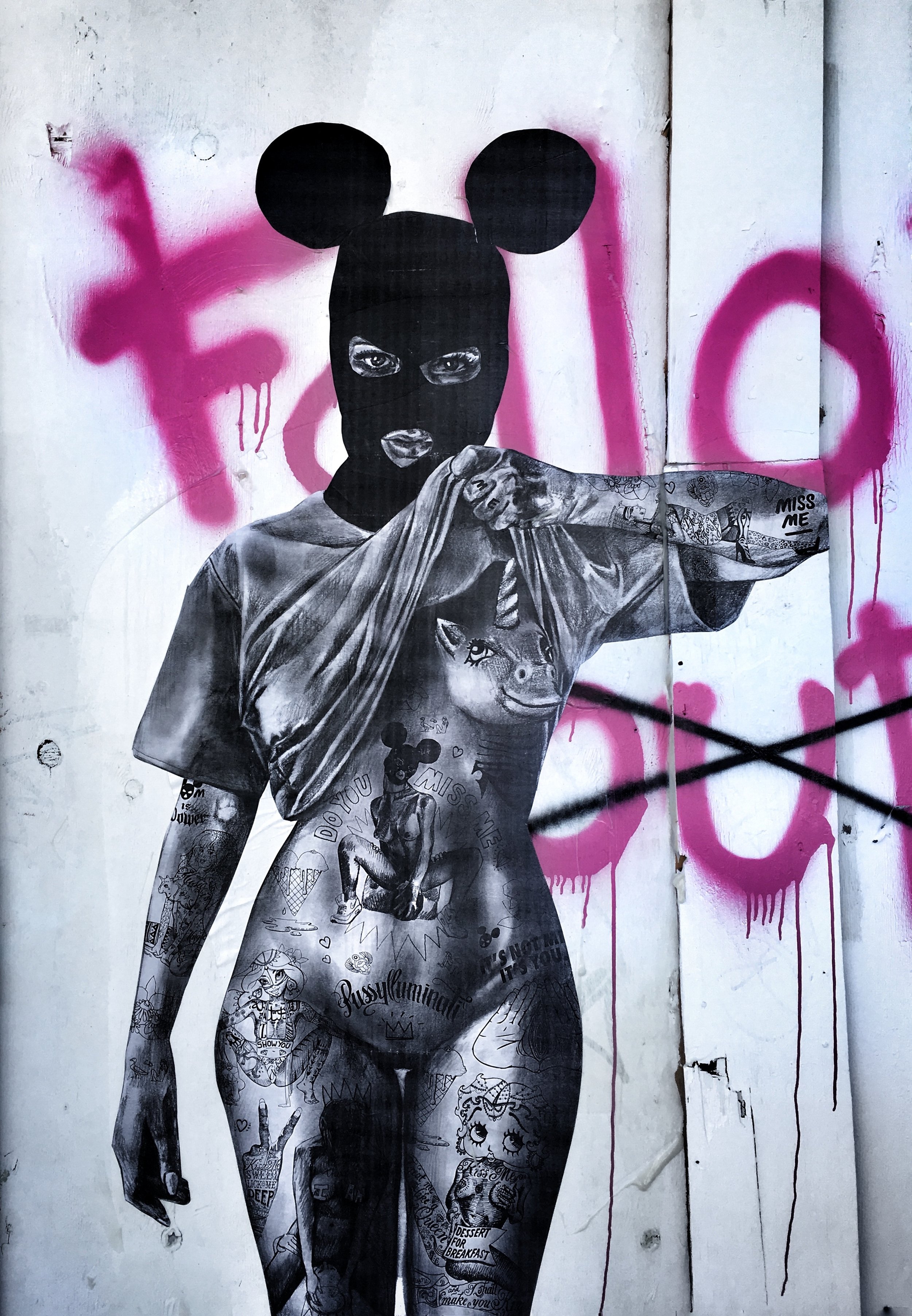
A graffiti artist from Montreal, the anonymous Miss Me, creates murals of a half- naked woman wearing a black mickey mouse ski- mask. The artist’s identity is unknown whilst she covers her face with a black mickey mouse ski- mask because it addresses the stereotypical ideation of a woman’s necessity wearing makeup; which also addresses the issues of society’s harsh judgement of what a woman should look like. Her name remains anonymous today, however she shares her personal experience of sexual violence and how it destroyed her for life as a woman. She grew up being bullied at school because of her mixed ethnicity with Jewish background. After her past experiences, she started creating elegant, and sometimes unsettling large-scale wheatpastes swallow buildings whole, confronting issues of dignity ­and forcing us to reconsider our own truths. Her past artworks are vandalized and at times, erased by angered citizens of Montreal and other areas; which influences the large realization that women of today are still treated unequal.

https://static1.squarespace.com/static/5660b6b9e4b05bfc47996bcb/57c45e1703596e8ebde72763/5a734435652dead0fdacca2c/1517503549090/IMG_1608+%281%29.jpg?format=2500w

Stay tuned for Freedom of art speech!

How post- modernism Reverses Canada’s Confederation: Fine Art paintings vs Kent Monkman

Every year, millions of Canadians gather together for Confederation Day, whilst remembering colonialism on Indigenous people. Throughout these past 150 years, the Hudson Bay trading posts, the Indian Act, residential schools and other historical events is what shaped Canada’s confederation. Despite colonialism, Canada is wonderful country because there are sugar shacks, cute beavers, the landscapes, friendly people and free health care. Along side of these advantages in Canada, the art is phenomenal that represent Canada’s country even more. Have you ever wondered what are the impacts Indigenous contemporary art have on society? It is not the Indigenous archival pieces from history, but the contemporary pieces that contain internal messages of both historical social contexts that changes society’s view of Canada.

The Founding Fathers (1968) by Rex Woods, Oil Painting, 12 ft x 7 ft. https://www.flickr.com/photos/57156785@N02/35800556525

Now that you learned Indigenous people are an essential part of Canada’s history, have you ever wondered why the Founding Fathers’ fine art paintings exclude Indigenous peoples? These Fine Art paintings are the most artistic representations of Confederation, but the Indigenous’ identity is nowhere to be found. The irony! Let’s analyze Kent Monkman’s, “The Daddies”, that subvert the notion of excluding Indigenous peoples in these Fine Art paintings.

Kent Monkman is an Indigenous contemporary artist that uses post- modernism to portray Indigenous identity in installation, film/video, performance, and oil paintings. He explores themes of colonization, sexuality, loss, and resilience – the complexities of historic and contemporary Indigenous experience. In most of his oil paintings, a gender-fluid character is identified. The gender-fluid character, Miss Chief Eagle Testikle, is portrayed as a supernatural being that time travels through Fine Art paintings; reversing colonialist patterns. With Monkman’s Miss Chief, his artwork won him the Egale Leadership Award (2012), the Indspire Award (2014), the Hnatyshyn Foundation Visual Arts Award (2014), the Bonham Centre Award (2017), an honorary doctorate degree from OCAD University (2017) and the Premier’s Award for Excellence in the Arts (2017).

One of my most favorite Kent Monkman paintings is, “The Daddies”, that depict a nude Miss Chief Eagle Testikle sitting in front of the Founding Fathers. As you analyze the painting, Miss Chief appears as if ‘”She’s trying to get a seat at the table, or she could be a hired entertainer.”’ Essentially, Miss Chief is Monkman’s secret weapon to manipulating colonialism narratives by mocking and humoring the place of confederation. Monkman additionally explored through themes of homophobia and how his outrageous Miss Chief character draws more attention by its audience; which gains more of the painting’s controversial content. He aimed for a complex diversity of Confederation Day, than a stereotypical perception of our home and Native land.

The Daddies (2016) by Kent Monkman, acrylic painting
60”x 112.5”.
https://www.theglobeandmail.com/news/national/canada-150/kent-monkman-shame-and-prejudice/article33515775/

When we visualize Canada Day, we imagine an image of Canada flags, fireworks, and happy families. However, Kent Monkman’s, “The Daddies”, does not fit in that national visualization because of his post- modernism that utilizes Miss Chief as a scandalous weapon. This weapon is the key tool to unveiling Canada’s traditions by rebelling against the stereotypes of Canada’s bubbly ideation. Not that having these ideations are wrong, but it is important to take colonialism into consideration while celebrating this year’s Canada Day.

Stay tuned for more Freedom of Art speech blogs!

The Mysteries behind Art: 2 simple linguistics that uncover an art meaning

Do you feel confused looking at an art work? Here are the basics of understanding the art language.

Certain art structures are difficult to analyze and can be confusing at a first glance; however there are two key linguistics that can easily unveil an artwork. Before I attended college in the arts program, I did not understand the language that artists portray in their art. But I always had a passion for making my own art since early childhood. When I was entering teen-hood, I visited the Montreal Museum of Fine arts for the first time when I was visiting my sister, who was attending college at the time. I did not have much interest in museums at that age because I got bored easily and thought it was pointless to even look at the art without having any knowledge of identifying imagery and language.

Believe it or not, anyone can struggle with understanding an art piece’s context and symbolism. Imagine your new friend, who attends an art school, invites you to an exhibition. You decide to go but have no clue why this art piece looks and is placed in a certain way, and you think to yourself, what the hell does this mean?

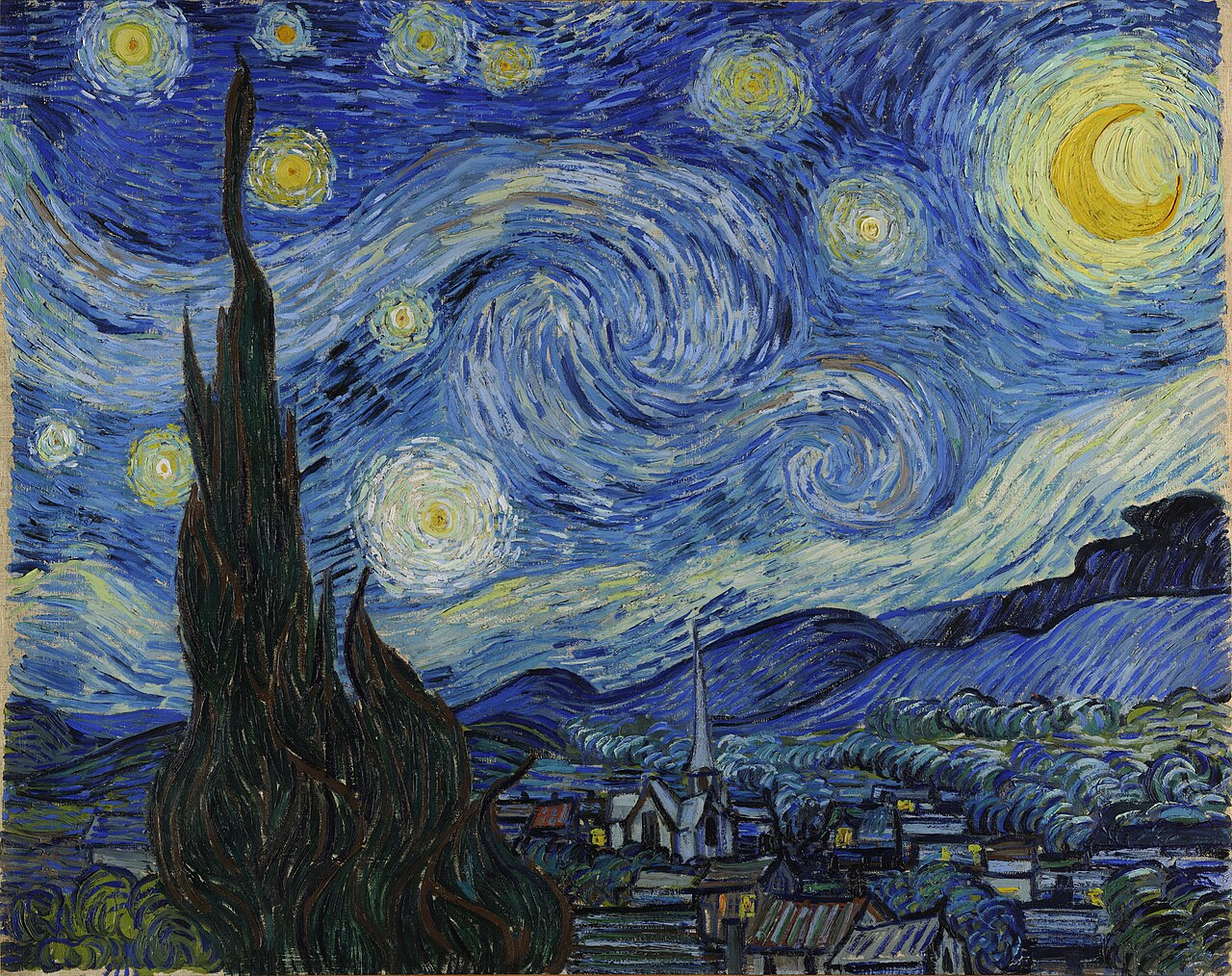
When entering an exhibition at an art museum, you notice a large white paper with the large text, Starry Night, mounted on the wall. Next to the large text is Van Goph’s famous painting, Starry Night. You immediately conclude that the text is Starry Night itself. But what is Starry Night? Is it the clear night sky we see every night, Van Goph’s painting, or the text? To define the image is to acknowledge its actuality of oil paint on a canvas, and to define a starry night is to see its ambiguous nature as you gaze up the night sky. Van Goph’s painting is not a starry night you see in the sky, but a painted image of a starry night. Overall, the linguistic structures are completely different dimensions that share a variety of contrasted meanings that also provide an impression of feeling, seeing, hearing and learning its context.

On the opposite side of semiotic language, you also acknowledge explicit paintings by its imagery. Each painting is historically connected to a specific art movement such as the realism era that included artists such as Gustave Courbet, Winslow Homer, and Édouard Manet. The art movement emerged in the 1850’s, and it was a time of not expressing how you felt, rather the simple imagery of realistic depictions of working- class people promoting the agricultural lifestyle at the time. At the end of the movement, Impressionism, a new art period established from 1860- 1890. Sadly, Impressionist artists were often rejected from the art industry and were labeled their style of artwork, outrageous, because of its simple yet complex content.

This is not a Pipe is an iconic semiotic artwork, made by Rene Magritte, that plays a part of contrasting the relationships between seeing things and identifying its name. Rene Magritte’s art was set in the Impressionism movement. At a first glance, you notice the depiction of the pipe and a written text, Ceci n’est pas une pipe, located below the image of the pipe. The first time I discovered this art piece, I could not understand its absurd content at all. We can all relate that it drives us insane to try and unveil its message.

Figure 1: Ceci n’est pas une pipe by Rene Magritte, The Treachery of Images (This is not a pipe). Alamy stock photo credits. Taken from https://www.sothebys.com/en/articles/21-facts-about-rene-magritte

In one of NERDWRITER’s Youtube videos, “What is The Treachery of Images?”, shares the connection of art languages, and one of the first artists that produced semiotic art. One of the most famous painters from the Impressionism movement, that also shared surrealism characteristics, Rene Magritte, did not consider himself an artist but he was more of a thinker that expressed his deep reflections in life. Throughout Magritte’s successful art career, his style remained stable and did not evolve. However, most of his inspirations stem from his written efforts in his part of the documented letters in Michael Foucault’s essay booklet, “This is Not a Pipe: Art Quantum”. In one blog, 21 Facts About Rene Magritte, written by Eva Sarah Molcord, shares Magritte perspective how “Art, as I understand it defies psychoanalysis…I take care to only paint pictures that evoke the mystery of the world…No sensible man believes that psychoanalysis could explain the mystery of the world.”

The deep messages behind art is uncovered through imagery and language. They play a major part of making a statement about social, historical and cultural concepts in an artwork. It is not as complex as you think it is. You observe what is happening in the art, why is the art made like that, who produced the art, where is the art located and its surroundings, how is the art associated to a specific subject/event and why the art portrays a specific message; what is the art piece telling you? If you enter an exhibition, you will notice what the exhibition is about just by reading the title and observing its area. Your sub-consciousness observes the obvious things, but the consciousness critically observes the art’s meaning by taking its history and concept into account. If you are feeling lost and confused at a museum a friend of yours dragged you to, do not be ashamed, it is just the beginning of artful communicating.

For more Freedom of Art Speech, stay tuned!