Do you feel confused looking at an art work? Here are the basics of understanding the art language.
Certain art structures are difficult to analyze and can be confusing at a first glance; however there are two key linguistics that can easily unveil an artwork. Before I attended college in the arts program, I did not understand the language that artists portray in their art. But I always had a passion for making my own art since early childhood. When I was entering teen-hood, I visited the Montreal Museum of Fine arts for the first time when I was visiting my sister, who was attending college at the time. I did not have much interest in museums at that age because I got bored easily and thought it was pointless to even look at the art without having any knowledge of identifying imagery and language.
Believe it or not, anyone can struggle with understanding an art piece’s context and symbolism. Imagine your new friend, who attends an art school, invites you to an exhibition. You decide to go but have no clue why this art piece looks and is placed in a certain way, and you think to yourself, what the hell does this mean?
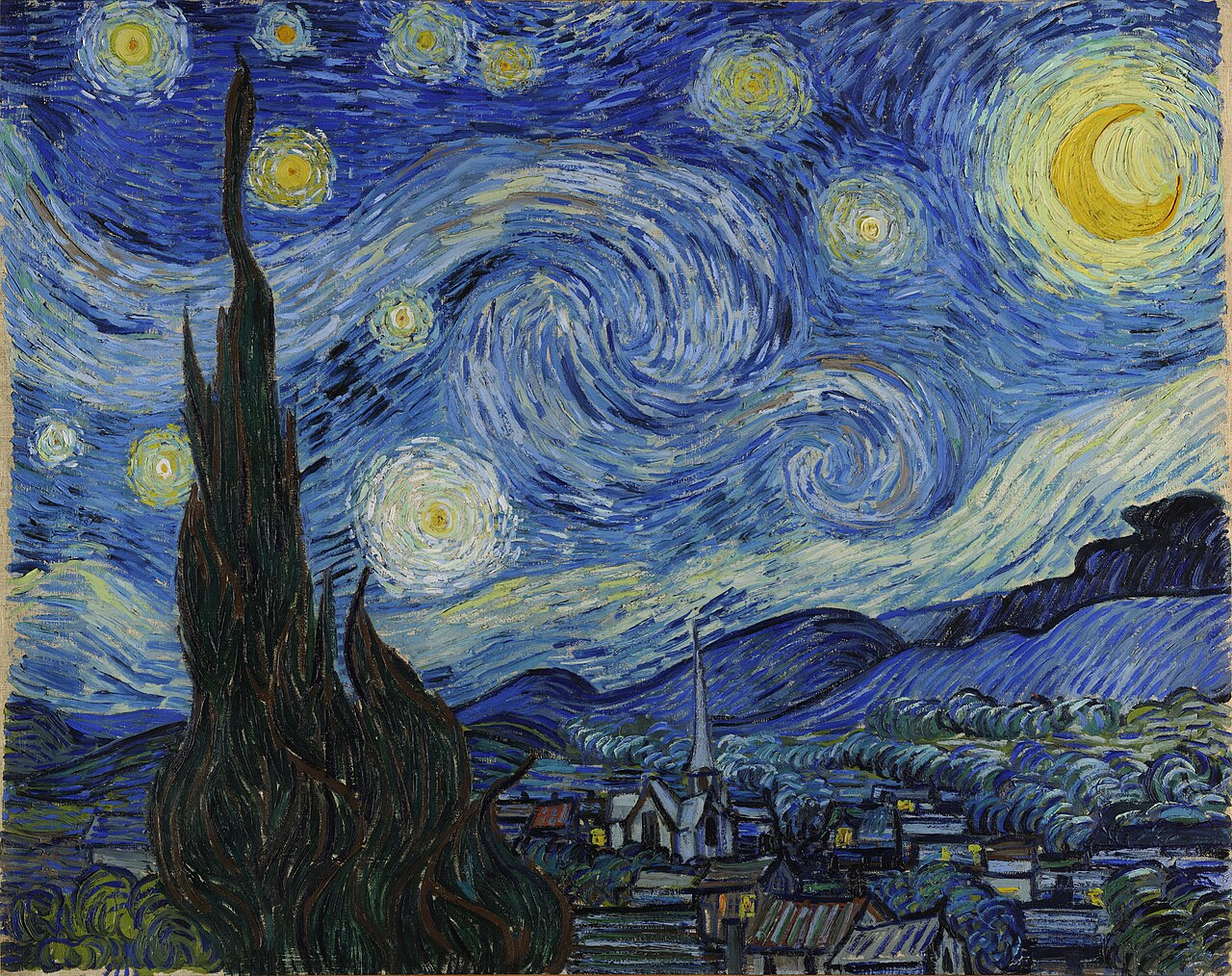
When entering an exhibition at an art museum, you notice a large white paper with the large text, Starry Night, mounted on the wall. Next to the large text is Van Goph’s famous painting, Starry Night. You immediately conclude that the text is Starry Night itself. But what is Starry Night? Is it the clear night sky we see every night, Van Goph’s painting, or the text? To define the image is to acknowledge its actuality of oil paint on a canvas, and to define a starry night is to see its ambiguous nature as you gaze up the night sky. Van Goph’s painting is not a starry night you see in the sky, but a painted image of a starry night. Overall, the linguistic structures are completely different dimensions that share a variety of contrasted meanings that also provide an impression of feeling, seeing, hearing and learning its context.
On the opposite side of semiotic language, you also acknowledge explicit paintings by its imagery. Each painting is historically connected to a specific art movement such as the realism era that included artists such as Gustave Courbet, Winslow Homer, and Édouard Manet. The art movement emerged in the 1850’s, and it was a time of not expressing how you felt, rather the simple imagery of realistic depictions of working- class people promoting the agricultural lifestyle at the time. At the end of the movement, Impressionism, a new art period established from 1860- 1890. Sadly, Impressionist artists were often rejected from the art industry and were labeled their style of artwork, outrageous, because of its simple yet complex content.
This is not a Pipe is an iconic semiotic artwork, made by Rene Magritte, that plays a part of contrasting the relationships between seeing things and identifying its name. Rene Magritte’s art was set in the Impressionism movement. At a first glance, you notice the depiction of the pipe and a written text, Ceci n’est pas une pipe, located below the image of the pipe. The first time I discovered this art piece, I could not understand its absurd content at all. We can all relate that it drives us insane to try and unveil its message.

In one of NERDWRITER’s Youtube videos, “What is The Treachery of Images?”, shares the connection of art languages, and one of the first artists that produced semiotic art. One of the most famous painters from the Impressionism movement, that also shared surrealism characteristics, Rene Magritte, did not consider himself an artist but he was more of a thinker that expressed his deep reflections in life. Throughout Magritte’s successful art career, his style remained stable and did not evolve. However, most of his inspirations stem from his written efforts in his part of the documented letters in Michael Foucault’s essay booklet, “This is Not a Pipe: Art Quantum”. In one blog, 21 Facts About Rene Magritte, written by Eva Sarah Molcord, shares Magritte perspective how “Art, as I understand it defies psychoanalysis…I take care to only paint pictures that evoke the mystery of the world…No sensible man believes that psychoanalysis could explain the mystery of the world.”
The deep messages behind art is uncovered through imagery and language. They play a major part of making a statement about social, historical and cultural concepts in an artwork. It is not as complex as you think it is. You observe what is happening in the art, why is the art made like that, who produced the art, where is the art located and its surroundings, how is the art associated to a specific subject/event and why the art portrays a specific message; what is the art piece telling you? If you enter an exhibition, you will notice what the exhibition is about just by reading the title and observing its area. Your sub-consciousness observes the obvious things, but the consciousness critically observes the art’s meaning by taking its history and concept into account. If you are feeling lost and confused at a museum a friend of yours dragged you to, do not be ashamed, it is just the beginning of artful communicating.
For more Freedom of Art Speech, stay tuned!

 Beginner's Guide to Understanding the Language of art