Montreal is a city filled with a diversity of art and everything about art such as graffiti. However, most graffiti pieces are not fully appreciated by the public since its subject used to be controversial back when its modern popularity arose. However, its origin’s date way back in the stone ages in cave paintings created by our ancestors. These cave paintings were depictions of our ancestor’s hunting stories, legends and war stories; since languages were limited at the time. In the 21st century, graffiti was originally rejected and still struggles for full acceptance by the public. Most graffiti pieces are either depictions of political and social messages. True to its purpose, it records human activity and overall history that express social and political content that may come off as controversial that trigger a particular- group, but also serve awareness and historical movements.
Since the beginning of 1970’s, hip-hop culture influenced many to start street art that consisted bright colorful spray paint on public areas. Most times, the act of spray painting was famously used by the group, the crews, to mark their territory away from other gangs. Graffiti art became famous by its unique styles of color and shapes, but it was debated whether it was an actual art form. It was hard to identify it as an art form because most places declared it as vandalism and illegal.
Throughout the years of different styles of spray painting, it struggled to make its acceptance to the public which inspired artists to create pieces that spread its expression against disapproval. Since both social and political graffiti art was portrayed offensive, it was best for most artists to conceal their identity from threats and direct negative feedback that only god knows what could happen to them.
One artist, Banksy, works with stencil graffiti that depicts social and political messages. The artist’s identity remains unknown and is believed to have been born in Bristol, England in 1974. Banksy began his graffiti career in the 1990’s when he began working with stencils. Following his artwork, he moved to London around 2000. One of his art work, Graffiti is a Crime, depicts two children reaching for a spray paint can that was crossed off with the sign, graffiti is a crime. Ironically, the title itself goes against the traditional notion of banning graffiti; which associates to the children rebelling against its social ideation of street art.
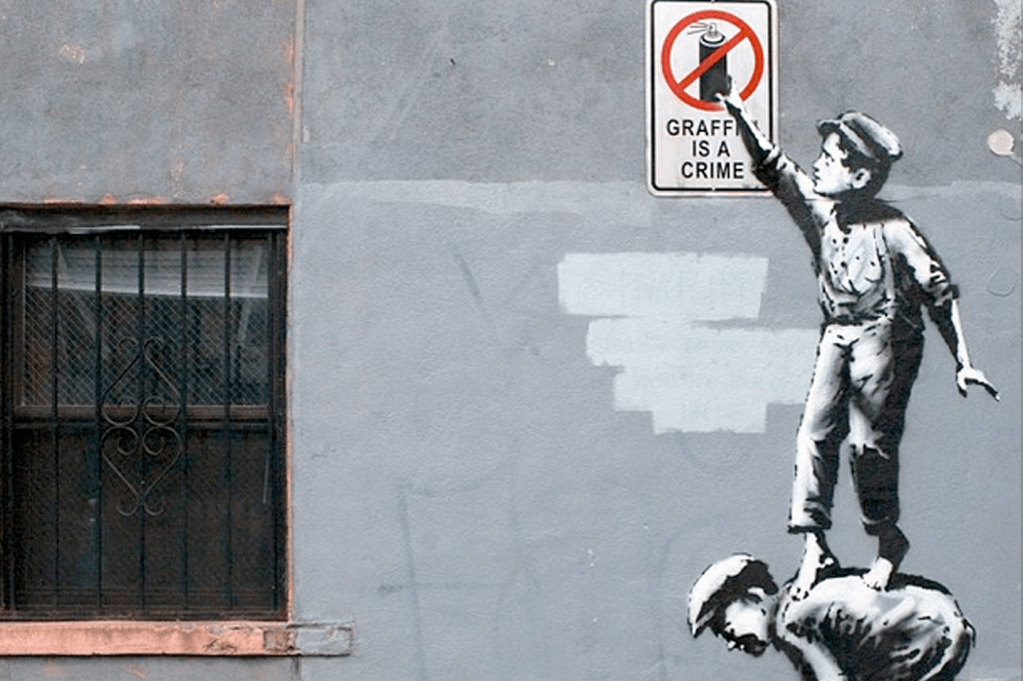
http://boredbug.com/wp-content/uploads/2014/11/graffiti-is-a-crime.png
Graffiti art has been known since the stone ages and became popular in modern times that expressed historical, social, and political issues within the public. Its practice and overall content is normally rejected by the public and government and is often seen as vandalism, which struggled to meet its acceptance in art form. The young generation may have a different, and more positive, perspective. However, the older generation that mainly own these public properties that contain beautiful street art murals, may have an issue with graffiti because of its non- traditional aesthetics and controversial content that may offend some. Although graffiti art is not entirely accepted by society’s perspective of art form, true art speaks to its viewers whether it brings the outcome of negative or positive feedback. Art surrounds us everywhere.

 Beginner's Guide to Understanding the Language of art
